Finding the right talent in Chennai takes careful planning. Companies compete for skilled professionals across IT, manufacturing, healthcare, finance, and engineering. The time needed to hire depends on the role, candidate availability, and internal hiring process. Working with an experienced recruitment consultant in Chennai helps businesses set realistic expectations, shorten hiring cycles, and recruit qualified professionals without compromising quality.
Whether you are expanding an existing team or hiring for a critical leadership role, understanding realistic recruitment timelines helps you plan better and avoid costly delays. This guide explains how long hiring usually takes in Chennai, what influences recruitment speed, and how organisations can improve their hiring process.
Chennai is one of India’s largest business hubs. The city has thriving IT parks, manufacturing clusters, Global Capability Centres (GCCs), healthcare institutions, and financial services companies. Demand for skilled professionals remains high throughout the year, making recruitment competitive across industries.
Several factors affect hiring timelines:
For example, hiring a customer support executive is usually much faster than recruiting a cloud architect, production head, or cybersecurity specialist. Each role requires different skills, experience, and recruitment strategies.
Although every organisation follows its own recruitment process, these timelines reflect common hiring patterns across Chennai.
Typical hiring time: 2 to 4 weeks
Entry-level recruitment usually moves quickly because organisations have access to a larger talent pool. Fresh graduates and early-career professionals often have shorter notice periods and can join sooner.
Common roles include:
Delays at this stage often occur because of slow interview scheduling or salary expectations that do not match the market.
Typical hiring time: 4 to 8 weeks
Mid-level hiring requires more detailed evaluation. Employers look for professionals with the right technical skills, industry knowledge, and the ability to contribute from day one.
Typical positions include:
Many candidates compare more than salary before accepting an offer. Career growth, work flexibility, learning opportunities, and company culture also influence their decision.
An experienced recruitment agency in Chennai helps employers keep candidates engaged throughout the hiring process. This reduces the chances of losing suitable applicants to competing offers.
Typical hiring time: 6 to 10 weeks
Hiring senior professionals takes longer because organisations assess leadership ability as well as technical expertise. Decision-makers also evaluate cultural fit, strategic thinking, and people management skills.
Typical roles include:
Most experienced professionals serve notice periods of 60 to 90 days. This is particularly common in Chennai’s IT and manufacturing sectors. Companies that begin recruitment only after an employee resigns often struggle to fill these positions quickly.
Typical hiring time: 8 to 12 weeks
Executive hiring demands careful planning and confidentiality. Organisations usually involve multiple stakeholders before making a final decision.
These positions include:
Recruitment at this level often includes several interview rounds, leadership assessments, background verification, and reference checks. Many businesses work with experienced hiring experts because they have access to senior professionals who are not actively searching for new opportunities.
Recruitment timelines also differ because every industry has unique hiring challenges.
Technology companies across OMR, Guindy, and Taramani compete for software developers, cloud engineers, cybersecurity professionals, AI specialists, and DevOps experts.
Typical hiring timelines include:
Long notice periods continue to slow recruitment in the IT sector. Many experienced professionals receive multiple offers before they complete their current commitments.
Manufacturing companies in Sriperumbudur, Oragadam, and nearby industrial corridors require engineers, production managers, maintenance specialists, and quality professionals with relevant industry experience.
Typical hiring timelines include:
Finding candidates with specialised manufacturing experience often extends the recruitment process. Employers also compete for professionals who understand modern production technologies and quality systems.
Banks, fintech companies, insurance providers, and NBFCs continue to expand across Chennai. These organisations look for candidates with technical expertise, analytical skills, and regulatory knowledge.
Typical hiring timelines include:
Background verification and compliance checks usually add extra time before candidates receive their final offer.
Hospitals, healthcare providers, and pharmaceutical companies continue to hire qualified professionals across Chennai.
Typical recruitment timelines include:
Professional licences, certifications, and specialised clinical experience often influence recruitment speed.
Hiring quickly should never mean compromising on quality. A structured recruitment process helps organisations fill vacancies faster while selecting candidates who are the right fit for the business.
Many hiring delays begin before recruitment starts. When job requirements change during the hiring process, recruiters must restart candidate searches or schedule additional interviews.
Before advertising a vacancy, hiring managers should finalise:
A clear job description helps recruiters identify suitable candidates more quickly. It also ensures everyone involved in the hiring process evaluates applicants using the same criteria.
Lengthy interview processes often result in losing good candidates. Skilled professionals rarely wait for one employer when they receive multiple interview calls.
For most positions, three interview stages are enough:
Quick scheduling and timely feedback improve the candidate experience. They also increase the chances of securing top talent before competitors do.
Salary continues to play an important role in hiring decisions. Companies that offer below-market packages often experience repeated offer rejections and longer hiring cycles.
Before making an offer, compare your salary range with current market expectations. Competitive compensation helps attract stronger candidates and improves offer acceptance rates.
Candidates appreciate regular updates throughout the hiring process. Even a short message after an interview keeps them informed and engaged.
Poor communication often creates uncertainty. Candidates may withdraw their applications or accept another offer if they do not receive timely updates.
Internal HR teams manage much more than recruitment. They also oversee onboarding, compliance, payroll, employee engagement, and performance management. During periods of expansion, balancing all these responsibilities can become challenging.
An experienced recruitment consultant helps organisations manage recruitment more efficiently by:
This support allows internal HR teams to focus on final hiring decisions instead of administrative tasks.
Local recruitment expertise also makes a difference. Chennai’s IT companies, manufacturers, healthcare providers, financial institutions, and Global Capability Centres all recruit differently. Salary expectations, notice periods, and candidate availability vary across sectors.
A trusted recruitment agency in Chennai understands these differences. This knowledge helps businesses develop realistic hiring plans and identify suitable candidates more efficiently.
Many organisations begin searching for candidates only after an employee resigns. This reactive approach often increases hiring pressure and extends vacancy periods.
Planning recruitment in advance offers several benefits:
Building a talent pipeline also makes recruitment easier for specialist and leadership roles, where candidate availability is often limited.
Hiring timelines vary across industries, roles, and organisations. Entry-level positions may be filled within a few weeks, while specialist and leadership roles often require much longer because of skill shortages, notice periods, and detailed evaluation processes.
Understanding these timelines allows HR teams to plan recruitment more effectively and minimise business disruption. Companies that prepare in advance and maintain an organised hiring process are more likely to secure the right talent without unnecessary delays.
Partnering with an experienced recruitment consultant in Chennai gives organisations access to wider talent networks, local hiring expertise, and structured recruitment support. Instead of simply filling vacancies, businesses can focus on building high-performing teams that contribute to long-term growth.
With more than ten years of recruitment experience across India, T&A HR Solutions helps organisations recruit confidently across industries and role levels. Our consultants understand Chennai’s employment market and work closely with employers to deliver quality candidates within realistic hiring timelines.
Most entry-level positions can be filled within two to four weeks. Mid-level professionals generally take four to eight weeks. Leadership and specialist roles often require eight to twelve weeks because of longer notice periods, multiple interviews, and detailed background verification.
Every industry has different recruitment needs. Technology companies compete for niche technical talent, while manufacturers look for professionals with specialised operational experience. Healthcare and financial organisations also have additional compliance and qualification requirements that can extend recruitment timelines.
A professional recruitment agency manages candidate sourcing, screening, interview coordination, follow-ups, salary discussions, and communication. This reduces administrative work for internal HR teams and helps organisations secure qualified candidates more efficiently.
Businesses should consider professional recruitment support when hiring for specialist positions, expanding teams, replacing senior leaders, or experiencing repeated hiring delays. Recruitment consultants provide access to larger talent networks and valuable local market insights that improve hiring outcomes.

Businesses across North India have witnessed remarkable changes in recruitment over the past decade. Recruitment consultants in Chandigarh have played an important role in helping organisations adapt to these changes by identifying qualified talent, understanding industry trends, and reducing hiring challenges. As competition for skilled professionals continues to increase, companies require recruitment strategies that are faster, smarter, and aligned with business goals.
Having spent more than 10+ years supporting employers across industries, T&A Solutions has experienced the evolution of Chandigarh’s employment market firsthand. From campus-driven hiring to specialised recruitment for emerging technologies, the city’s workforce has become increasingly competitive. This article shares practical hiring lessons that can help employers make better recruitment decisions while preparing for future workforce needs.
According to LinkedIn’s Global Talent Trends report, skills-based hiring and internal mobility continue to reshape recruitment strategies as employers compete for specialised talent.
For over a decade, many businesses filled vacancies through employee referrals, newspaper advertisements, or local college placements. While these methods still contribute to recruitment, they are no longer sufficient in today’s competitive employment market.
Several factors have transformed hiring across Chandigarh:
As Chandigarh continues attracting professionals from Punjab, Haryana, Himachal Pradesh, Delhi NCR, and neighbouring states, businesses have access to a broader talent pool. However, this also means employers compete with organisations offering attractive compensation, flexible work arrangements, and stronger career opportunities.
Companies that continue using outdated hiring practices often experience longer recruitment cycles, higher employee turnover, and increased hiring costs.
Every employment market has unique hiring patterns, and Chandigarh is no exception. Experienced recruitment consultants in Chandigarh like T&A Solutions understands regional talent availability, salary benchmarks, industry demands, and candidate expectations far better than organisations recruiting independently.
This local knowledge enables them to recommend hiring strategies that reduce recruitment time while improving candidate quality.
Different industries require different recruitment approaches.
For example:
Knowing where to source these professionals and how to approach passive candidates is how they’ve significantly improved their hiring success.
Today’s professionals evaluate much more than salary before accepting an offer.
They commonly consider:
T&A Solutions regularly interact with candidates, understand these priorities and help employers position opportunities more effectively.
Recruitment requirements have become significantly more specialised over the last decade.
Earlier, organisations often hired professionals capable of handling multiple responsibilities. Today, businesses increasingly seek candidates with expertise in niche areas such as:
Finding these professionals requires targeted sourcing, technical screening, and industry knowledge is what T&A Solutions have been doing for over a decade now.
Experience combined with local market understanding with specialised recruitment techniques help organisations identify qualified professionals more efficiently.
NASSCOM reports that India’s demand for digital talent continues to grow rapidly, increasing competition for professionals with expertise in AI, cloud computing, cybersecurity, and data analytics.
As businesses expand, internal HR departments often spend significant time on repetitive recruitment tasks rather than strategic people management.
Common responsibilities include:
Partnering with an experienced HR outsourcing agency in Chandigarh allows HR teams to focus on employee engagement, learning and development, performance management, and retention while recruitment specialists manage hiring activities.
However, outsourcing should complement internal HR expertise rather than replace strategic decision-making.
Despite access to modern recruitment technology, many organisations continue to face avoidable hiring challenges. One lesson learned over the past decade is that successful hiring depends on planning, speed, and clear communication rather than simply posting vacancies.
Some of the most common mistakes include:
Qualified candidates rarely remain available for long. Slow interview scheduling or delayed offer approvals often result in losing top talent to competing employers.
Technical expertise is essential, but communication, adaptability, leadership potential, and cultural fit are equally important for long-term success. Businesses that evaluate both technical and behavioural competencies generally achieve stronger employee retention.
Vague job descriptions attract unsuitable applications while discouraging qualified professionals. Clear expectations, defined responsibilities, and transparent growth opportunities help employers attract better candidates.
Organisations that build talent pipelines throughout the year are better prepared for expansion than businesses that begin recruiting only after employees resign.
Every industry requires a different hiring approach. A recruitment strategy that succeeds in IT may not deliver similar results in manufacturing or healthcare.
Technology companies compete for software developers, cloud engineers, cybersecurity professionals, DevOps specialists, AI engineers, and data analysts. Recruitment success depends on technical screening, proactive sourcing, and quick hiring decisions.
Manufacturing organisations typically recruit production managers, quality specialists, maintenance engineers, plant heads, procurement professionals, and supply chain experts. Industry knowledge and practical experience often outweigh academic qualifications.
Hospitals and healthcare providers seek qualified doctors, nurses, technicians, and hospital administrators who combine technical expertise with patient-focused communication and regulatory compliance.
Startups generally look for professionals who demonstrate adaptability, ownership, and the ability to manage multiple responsibilities. Hiring decisions often prioritise attitude and learning ability alongside technical competence.
Large organisations frequently recruit across multiple business functions simultaneously. Working with T&A solutions helps standardise hiring processes while reducing administrative workloads during rapid expansion.
Selecting the right recruitment consultancy involves more than comparing placement fees. Employers should evaluate whether the recruitment partner understands their industry, workforce challenges, and long-term hiring objectives.
Before making a decision, consider asking:
A reliable recruitment partner like T&A solutions provides realistic expectations, transparent communication, and measurable hiring outcomes instead of making unrealistic promises.
The Chandigarh employment market will continue evolving as industries expand, technology advances, and workforce expectations change. Organisations that invest in structured recruitment strategies, realistic hiring expectations, and experienced recruitment support are better positioned to attract and retain skilled professionals.
Rather than treating recruitment as a one-time activity, successful businesses view hiring as an ongoing investment that directly supports productivity, innovation, and sustainable growth.
By partnering with T&A Solutions, employers gain access to wider talent networks, industry expertise, and efficient hiring processes that complement their internal HR capabilities.
Over the past decade, Chandigarh has emerged as one of North India’s strongest employment markets. Hiring today requires more than advertising vacancies—it demands market intelligence, structured recruitment processes, and an understanding of changing candidate expectations.
Experienced recruitment consultants help businesses navigate these challenges by providing access to qualified professionals, industry knowledge, and recruitment expertise tailored to specific hiring needs.
T&A Solutions has spent more than ten years supporting employers across India with recruitment, executive search, staffing, HR consulting, Recruitment Process Outsourcing (RPO), and manpower solutions. Its ethical recruitment practices and strong understanding of Chandigarh’s talent market have helped businesses build capable teams across multiple industries.
Looking to strengthen your hiring strategy? Contact T&A Solutions today to discuss your recruitment requirements and discover how experienced recruitment consultants can help your business attract and retain the right talent.
1. Why should businesses work with recruitment consultants in Chandigarh?
Experienced recruitment consultants understand local hiring trends, salary expectations, candidate availability, and industry-specific recruitment challenges. Their expertise helps businesses reduce hiring time while improving candidate quality.
2. When should a company consider an HR outsourcing agency in Chandigarh?
Businesses often choose HR outsourcing when recruitment volumes increase, specialised hiring support is required, or internal HR teams need additional recruitment expertise while focusing on strategic HR functions.
3. Can recruitment consultants help with specialised hiring?
Yes. Recruitment consultants regularly support hiring for specialised technical, managerial, leadership, and executive roles across industries such as IT, manufacturing, healthcare, logistics, retail, pharmaceuticals, and engineering.
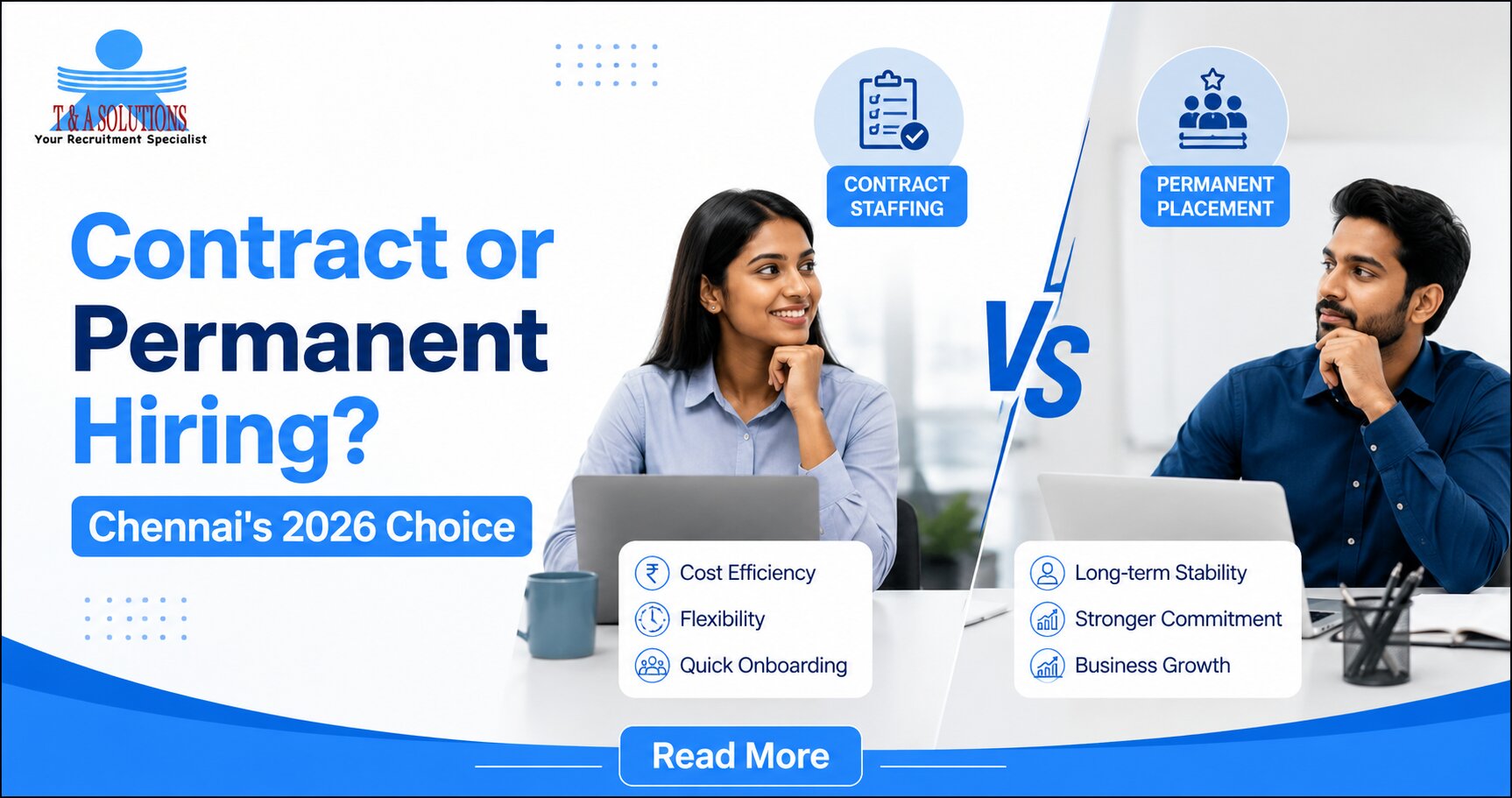
Hiring the right talent is no longer only about filling open positions. For companies operating in competitive markets, workforce decisions directly impact project delivery, operational efficiency, and long-term growth.
Startups need the flexibility to scale teams quickly. IT companies often require specialised professionals for time-bound projects. Manufacturing businesses may need additional workforce during expansion phases. Healthcare institutions require dependable talent to maintain operational continuity.
This creates an important question for HR teams and business leaders: should they choose contract staffing or permanent placement?
Selecting the wrong hiring model can result in delayed projects, increased recruitment effort, and workforce challenges. This is why many organisations seek support from an experienced manpower consultancy in Chennai to evaluate their requirements and identify the right talent acquisition approach.
Contract staffing and permanent placement are not competing solutions. Both serve different business needs. The right choice depends on factors such as role importance, project duration, workforce flexibility, skill availability, and future business plans.
This guide explains how companies can compare both models and decide which approach works best for their hiring strategy in 2026.
Before selecting a recruitment model, businesses need clarity on how contract staffing and permanent placement work.
Contract staffing is a workforce solution where professionals are hired for a defined period, specific project, seasonal requirement, or temporary business need.
In this model, companies gain access to skilled professionals while maintaining flexibility in workforce planning. The staffing partner supports candidate sourcing, screening, and recruitment coordination based on the organisation’s requirements.
Contract staffing is commonly used by:
For example, an IT firm receiving a large software development project may require additional developers, testers, cybersecurity specialists, or cloud professionals for a specific timeline. Instead of permanently expanding the workforce, the company may use contract staffing to access experienced talent during the project period.
A professional manpower staffing agency helps organisations identify suitable candidates while ensuring that workforce requirements are aligned with business objectives.
Permanent placement focuses on hiring professionals for long-term roles within an organisation. The selected candidates become permanent employees and contribute to the company’s operations, culture, and future growth.
Permanent hiring is generally preferred for roles where continuity, ownership, and long-term expertise are important.
Companies commonly choose permanent placement for:
For example, a manufacturing company setting up a new production facility may prefer permanent hiring for plant managers, engineering leaders, and quality specialists because these roles require ongoing involvement and organisational understanding.
Experienced Indian HR consultants often help businesses determine whether a role requires long-term commitment or short-term workforce flexibility.
The right hiring model depends on the business situation, not just the vacancy itself.
A common mistake organisations make is selecting one approach for every role. In reality, successful companies often use a combination of contract staffing and permanent recruitment depending on their workforce requirements.
Contract staffing is useful when companies require skilled professionals quickly or need workforce flexibility.
Businesses may consider contract staffing when they need:
For example, a technology company launching a new application may require additional developers and quality analysts for the development cycle. Contract professionals can support project delivery while the organisation maintains control over long-term workforce planning.
Similarly, a manufacturing company experiencing increased production demand may require additional operational support without permanently increasing employee numbers.
Permanent recruitment is more suitable for roles that directly contribute to long-term business growth.
Companies generally prefer permanent hiring when they need:
Permanent employees often become valuable contributors because they build institutional knowledge and develop expertise within the organisation.
For example, a growing startup may initially use flexible staffing solutions but later hire permanent product managers, technology leaders, and operations specialists as the business becomes more established.
Before deciding between contract staffing and permanent placement, HR teams should evaluate several practical factors.
The role itself is one of the most important considerations.
Temporary projects, seasonal requirements, and urgent skill requirements often work well with contract staffing.
Roles that influence business strategy, leadership, customer relationships, or long-term operations generally benefit from permanent hiring.
Businesses working with strict deadlines may need faster access to talent.
Contract staffing can help companies quickly connect with available professionals, while permanent recruitment usually involves a more detailed assessment process to ensure long-term suitability.
Companies operating in industries with changing demand may benefit from flexible staffing models.
For example:
In such cases, contract staffing provides the ability to adjust workforce capacity according to business requirements.
Certain specialised skills may require access to wider talent networks.
Recruitment experts understand market availability and candidate expectations, helping organisations identify suitable professionals more efficiently.
The best workforce strategy often combines multiple hiring approaches.
Many organisations use:
A reliable manpower consultancy in Chennai can help businesses create a balanced approach based on immediate requirements and future growth objectives.
In 2026, many businesses are moving towards a more balanced workforce strategy instead of depending only on permanent recruitment or contract staffing.
A hybrid hiring approach allows companies to combine different talent models based on business requirements. This means organisations can maintain permanent teams for critical functions while using contract professionals for specialised projects or temporary workforce needs.
This approach is becoming increasingly relevant because businesses need both stability and flexibility.
For example:
This balanced approach helps businesses manage workforce requirements more effectively without compromising on talent quality.
Experienced hiring experts recommend evaluating every role individually instead of applying the same recruitment model across the entire organisation.
Different industries have different workforce challenges. The ideal hiring strategy depends on operational requirements, skill availability, and business objectives.
Technology companies often experience changing project requirements and evolving skill demands. A project may require specialists in areas such as software development, cloud technology, cybersecurity, data engineering, or testing for a limited period.
Contract staffing can help IT firms:
At the same time, permanent hiring remains important for roles such as technology leadership, product management, architecture, and core engineering teams.
Manufacturing businesses often require workforce planning that supports both operational stability and production flexibility.
Permanent recruitment is generally suitable for:
Contract staffing can support:
A recruitment partner with industry understanding can help manufacturing companies identify the right workforce mix.
Healthcare organisations require dependable professionals because workforce availability directly impacts service quality.
While many healthcare roles require permanent employees, contract staffing can provide additional support during:
A structured recruitment approach helps healthcare institutions maintain workforce continuity while responding to changing needs.
Startups often face unique hiring challenges. They need skilled professionals but may also need flexibility while validating business models and scaling operations.
A startup may begin with a combination of contract professionals and permanent employees before building a larger internal team.
The right recruitment strategy allows startups to:
Choosing the wrong workforce model can create unnecessary challenges. Businesses should avoid making recruitment decisions based only on short-term requirements.
Some common mistakes include:
If a role exists only for a short-term project, permanent hiring may create unnecessary workforce commitments after the requirement ends.
Some roles require ownership, continuity, and deep organisational knowledge. These positions may benefit more from permanent recruitment.
The cheapest hiring option is not always the most effective. Companies should consider factors such as productivity, skill quality, project impact, and long-term value.
Recruitment becomes more effective when companies understand their future talent requirements instead of hiring only when urgent vacancies arise.
Professional recruitment partners help businesses plan ahead and build sustainable hiring strategies.
T&A Solutions helps organisations across India with recruitment, staffing, talent acquisition, and workforce solutions. The company supports businesses looking for reliable hiring assistance across industries including IT, manufacturing, healthcare, and other corporate sectors.
With expertise in permanent staffing, manpower consulting, executive search, bulk hiring, and recruitment support, T&A Solutions helps companies connect with suitable professionals based on their specific requirements.
The recruitment approach focuses on understanding:
For organisations requiring flexible workforce solutions, T&A Solutions provides support through staffing expertise and talent acquisition capabilities.
For businesses looking to build long-term teams, the company assists with identifying professionals who match both technical requirements and organisational expectations.
Companies searching for a trusted Hiring agency in Chennai can benefit from working with recruitment experts who understand local talent availability while supporting hiring requirements across India.
Recruitment challenges are often not limited to finding candidates. Businesses also need support in evaluating skills, understanding market conditions, and selecting professionals who match their requirements.
A professional recruitment partner provides value through:
For startups, this can help create efficient hiring systems. For established organisations, recruitment support can improve workforce planning and support expansion.
The role of recruitment experts is not only to fill positions but also to help businesses make informed workforce decisions.
The choice between contract staffing and permanent placement depends on the organisation’s goals, role requirements, and future plans.
Contract staffing provides flexibility for project-based work, changing workforce requirements, and specialised skill needs. Permanent placement helps companies build stable teams, strengthen organisational culture, and develop long-term expertise.
The most effective approach is often a combination of both models. Businesses that carefully evaluate their workforce requirements can create hiring strategies that support productivity, growth, and operational success.
Working with an experienced manpower consultancy in Chennai helps organisations understand their options and connect with suitable professionals more efficiently.
T&A Solutions supports businesses with recruitment and staffing solutions designed around their specific hiring needs. Whether your organisation requires contract professionals, permanent employees, or specialised talent acquisition support, the right recruitment strategy can help you build a stronger workforce.
Contract staffing provides professionals for a specific period, project, or temporary requirement, while permanent placement focuses on long-term employment. Companies choose between these models based on factors such as business needs, role importance, workforce flexibility, and future growth plans.
Companies should consider contract staffing when they need quick access to skilled professionals, support for temporary projects, additional workforce during demand changes, or specialised expertise for a limited period.
Neither option is universally better. Permanent recruitment works well for strategic roles requiring long-term involvement, while contract staffing is suitable for flexible workforce requirements. The right choice depends on the company’s objectives and the role being filled.
A manpower consultancy helps organisations identify hiring requirements, source suitable candidates, evaluate profiles, and support recruitment processes. This enables companies to save time and make better workforce decisions.
Businesses should consider recruitment experience, industry understanding, hiring processes, candidate quality, and service capabilities when selecting a hiring agency. A reliable recruitment partner should provide transparent guidance and understand the organisation’s specific workforce requirements.